Global buyers need more than a plug that fits the wall. Selecting the right AC DC adapter requires careful attention to voltage, current, polarity, connector size, and regional input requirements. Power Adapter Ac Dc products serve routers, LED equipment, medical devices, office electronics, and industrial controls. Each application creates different performance expectations.
Common types include wall-mounted adapters, desktop power supplies, interchangeable-plug models, USB power adapters, and enclosed industrial units. Wall adapters save space beside a home router. Desktop models often provide stronger output for monitors or networking equipment. Interchangeable plugs can simplify international distribution, but their mechanical fit deserves close inspection. Small details matter. A loose connector can interrupt a production line.
Practical sourcing experience shows that wattage alone cannot confirm suitability. Buyers should review output stability, operating temperature, energy efficiency, cable length, and protection against overvoltage or short circuits. Regional certification requirements also need verification before purchase. A familiar compliance mark may not cover every destination market. Supplier test reports, traceable specifications, and product samples provide stronger evidence than attractive catalog images.
One assumption can fail.
For this reason, a reliable buying guide should compare adapter types by application, portability, safety features, and long-term serviceability. It should discuss real installation conditions, including heat, dust, limited socket space, and continuous operation. The cheapest option may look efficient on paper, yet replacement costs can quickly change the calculation. Better decisions come from balancing verified performance, supplier transparency, and the equipment’s actual power needs.
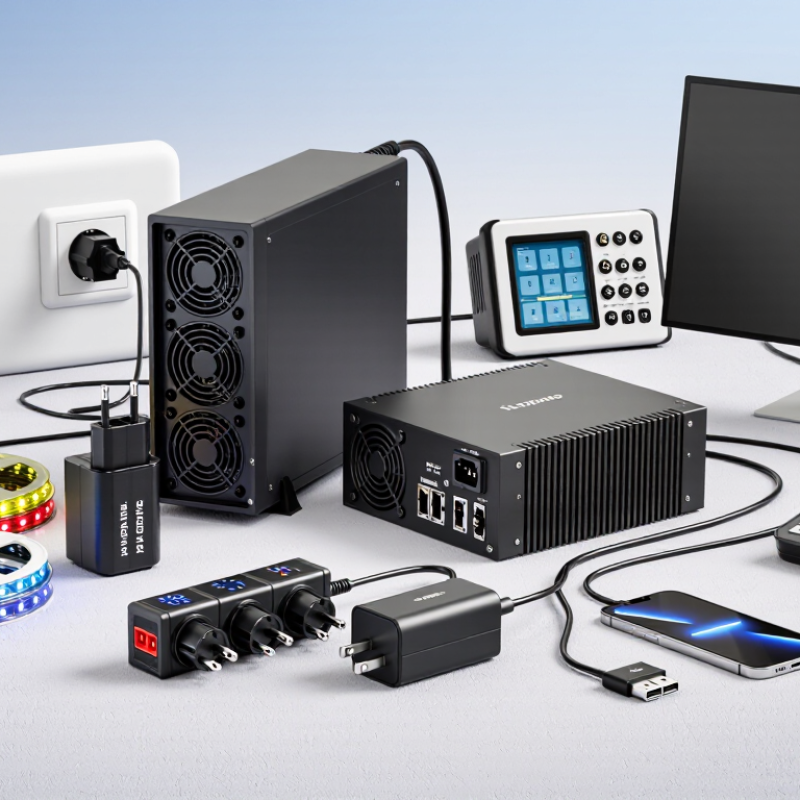
AC-DC Adapter Fundamentals: Input Ranges, Outputs, and Efficiency Ratings
AC-DC adapters convert wall power into stable direct current for electronic equipment. Global buyers should check the input range before comparing prices. Many travel-ready models accept 100–240 VAC at 50 or 60 Hz. That range supports different electrical systems without a manual voltage switch. Narrower input ranges may require regional versions. This is easy to overlook.
The output must match the device’s voltage and polarity. A 12 V device needs a regulated 12 V DC supply, not an approximate value. The adapter’s current rating should meet or exceed the equipment’s requirement. A 2 A adapter can usually power a device needing 1.5 A. The connector size also matters. Small differences can prevent a secure connection. Efficiency ratings show how much input energy becomes usable output. Higher efficiency normally means less heat, lower operating waste, and improved reliability. However, ratings can vary with load, so peak performance may not reflect everyday use. Safety documentation, insulation design, and over-current protection deserve equal attention.
Tips: Request test data at 25%, 50%, and 100% load. Check no-load power consumption. Confirm plug compatibility for each destination. I also recommend reviewing the label twice. A clear specification sheet can still contain an unnoticed polarity error. When requirements are uncertain, test a sample under real voltage and temperature conditions before placing a larger order.
Top Types of AC-DC Power Adapters for Global Buyers
Representative efficiency targets for common AC-DC adapter categories. Actual performance varies by rated load, input voltage, power factor requirements, thermal design, and applicable regional standards.
Most globally distributed adapters support a universal 100–240 V AC input at 50/60 Hz. USB-C PD models commonly provide 5–20 V DC outputs, while higher-power desktop and external adapters may deliver fixed or programmable outputs up to approximately 48 V DC.
Linear vs. Switching Adapters: Why Global Buyers Prefer High-Efficiency Designs
Top Types of AC DC Power Adapters for Global Buyers
Linear adapters remain simple, quiet, and predictable, but they waste more energy as heat. A 12-volt linear unit can feel warm even under moderate load. Switching adapters use high-frequency conversion, smaller transformers, and tighter control circuits. This design usually delivers higher efficiency across international voltage ranges, from 100V to 240V AC.
Efficiency is now a purchasing requirement, not a marketing detail. The U.S. Department of Energy’s Level VI requirements limit no-load consumption to 0.1 watts for many lower-power adapters. European Commission Regulation (EU) 2019/1782 applies a similar 0.10-watt limit for models up to 49 watts. These figures matter when thousands of adapters remain plugged in overnight. Small losses become measurable operating costs.
In practical sourcing checks, buyers should examine active-mode efficiency, standby power, thermal performance, ripple, and safety documentation. A 65-watt switching adapter may run cooler inside a crowded equipment cabinet. That can extend component life, although it is not guaranteed. Switching designs can also create electromagnetic noise, especially when filtering is weak. This is where technical testing matters. The International Energy Agency has repeatedly identified efficiency improvements in small electrical loads as part of broader electricity-saving strategies. Still, global buyers sometimes choose the cheapest unit first. That decision can overlook unstable output, regional certification gaps, and poor performance at light loads.
Safety and Compliance: IEC 62368-1, DOE Level VI, and EU CoC Tier 2
Top Types of AC DC Power Adapters for Global Buyers
Global buyers should treat safety and efficiency as design requirements, not paperwork. IEC 62368-1 evaluates electrical, thermal, mechanical, and energy-related hazards in modern electronic equipment. For adapters, buyers should request valid test reports, construction details, and evidence that the tested model matches production units. A familiar housing means little if internal insulation or creepage distances differ.
DOE Level VI focuses on energy efficiency and no-load power consumption in the United States. It can reduce wasted electricity when an adapter remains plugged in overnight.
EU CoC Tier 2 sets demanding efficiency expectations for external power supplies in Europe. It is generally a voluntary code, so buyers should confirm whether a project requires it contractually or through customer policy. Requirements can change. That part deserves a second check.
Tips:
Inspect the label, output plug, cable rating, and country markings before approval. Ask for reports from a competent laboratory, not only a supplier declaration. Check operating temperature with the adapter fully loaded; a cool sample at half load proves very little. Small labels matter. I have seen otherwise convincing samples fail because the printed input range did not match the actual test configuration. Keep revision-controlled documents, and recheck compliance after any transformer, enclosure, firmware, or component change.
Conclusion
AC-DC adapters convert alternating current from wall outlets into stable direct current for electronic devices, with input ranges, output voltage, current capacity, and efficiency ratings determining their suitability. Compared with traditional linear designs, switching adapters are generally lighter, cooler, and more energy efficient, making them a preferred choice for global buyers. A reliable Power Adapter Ac Dc should also provide consistent output and support the electrical requirements of the target device.
For international markets, universal-input models accepting 100–240 V can operate across different regional power systems with minimal configuration. USB-C Power Delivery adapters further expand flexibility, supporting applications from basic 5 W charging to high-power outputs reaching 240 W when properly designed. Safety and regulatory compliance are equally important, including IEC 62368-1, DOE Level VI, and EU CoC Tier 2 requirements. Evaluating electrical performance, thermal management, connector compatibility, and certification helps buyers select efficient, safe, and globally suitable adapters.