A car adapter can look simple: one plug, a short cable, and a familiar socket. Choosing the right one takes more care. Vehicle outlets vary, and an adapter’s input, output, and rated wattage must suit both the car and the device. A compact charger may handle a phone well but struggle with a laptop or other demanding equipment. Small details matter.
Engineering professor and author Henry Petroski wrote, “Science is about knowing; engineering is about doing.” It is a useful lens for comparing an Ac Dc Power Adapter For Car: specifications matter most when they match real use. Check the connector, supported voltage, continuous power rating, and stated protections against overheating or overload. Also consider cable reach. A cord that barely reaches the passenger seat becomes irritating fast.
This guide reviews seven options for 2026, focusing on practical fit, power capability, and everyday usability. Some models suit short commutes and modest electronics. Others offer more output for longer trips, but higher ratings do not automatically mean a better choice. Read the product label and your device’s power requirements before buying. Claims can be incomplete, too. That deserves a careful second look. The comparisons that follow aim to make those trade-offs easier to judge, without treating one adapter as right for every vehicle.
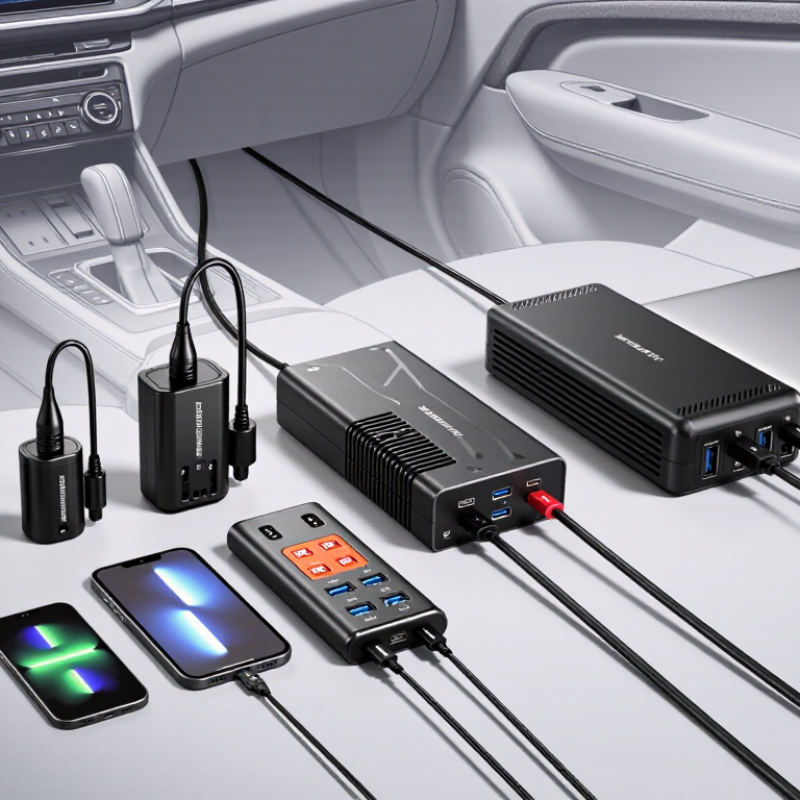
A car’s accessory socket supplies direct current, not household alternating current. That distinction matters. An adapter designed only for a wall outlet may not work in a vehicle unless the car provides an inverter or AC outlet. Many automotive chargers instead accept the car’s DC input, then regulate it to a stable voltage for a phone, camera, or small device. Inside, conversion circuits reduce voltage, smooth electrical fluctuations, and limit current. Heat is the trade-off: a compact adapter can feel warm during extended use, especially under a heavy load.
Check the adapter’s input range and output rating against the device, not just the plug shape. SAE J563 describes the common 12-volt automotive accessory receptacle, but a vehicle’s operating voltage can vary while its engine runs. USB-IF’s USB Power Delivery 3.1 specification supports up to 240 watts with Extended Power Range; that figure describes the protocol’s ceiling, not what a car socket can safely deliver. The socket, wiring, and adapter may impose lower limits. I still treat printed wattage as a starting point, not a guarantee. A loose plug can interrupt charging over rough pavement, and a poor fit is easy to overlook. Check it after installation.
A car power adapter should match both the vehicle’s DC supply and the device’s required input. Check the adapter’s input-voltage range, then confirm its AC output voltage and frequency suit your equipment. Small numbers matter. A laptop may need steady power, while a small pump can draw extra current when starting.
Compare continuous wattage, not just the larger peak-watt figure printed on a package. Peak output usually lasts only briefly. Leave capacity for startup surges, and check whether the unit produces a pure sine wave or a modified waveform. Some sensitive electronics work better with pure sine output. Also note the available connections: AC sockets, USB ports, or a direct DC output. Count what you will actually use.
Look for overload, overheating, short-circuit, and low-voltage protection. A built-in fuse and a clear status display are practical details, not decoration. Check the vehicle outlet’s rating before connecting a high-load adapter; a socket can feel warm under sustained use. Ventilation matters, too, especially on a sunny dashboard. I would not treat a large wattage claim as proof of quality. Specifications can be incomplete, so verify them against the device’s label and the vehicle manual.
Choosing among seven adapter types starts with one basic question: where does the power come from? A car’s 12-volt socket supplies DC, while a household outlet supplies AC. They are not interchangeable. A single-port USB-C car adapter suits a phone or tablet; a dual-port USB-A/USB-C model can charge older and newer devices together. A multiport charger adds flexibility, but check its shared output limit. A fused 12-volt barrel-plug adapter works for compatible small electronics. A regulated laptop adapter can fit a specific device, provided its voltage, connector, and polarity match exactly.
For higher, steady loads, consider a fused hardwired DC-to-DC converter installed according to its instructions. A household AC-to-DC wall adapter is useful for powering compatible gear in a garage, but it cannot plug directly into a car’s DC socket. Small details matter. Check the device’s required voltage and current, the adapter’s maximum output, and whether the vehicle socket is fused. Avoid covering an adapter that grows warm; airflow matters. I’d still verify the manual, even when the plug fits. Fit alone proves very little. Some product labels are confusing, so compare the input and output specifications rather than relying on the word “car.”
| Adapter Type | Typical Vehicle Input | Typical Output | Typical Power Rating | Connection | Suitable Uses | Important Limitation |
|---|---|---|---|---|---|---|
| Compact USB-A car adapter | 12–24 V DC | 5 V DC; commonly up to 2.4 A per port | Up to about 12 W per port | Vehicle accessory socket | Phones, small USB accessories, and basic charging | Usually lacks USB-C Power Delivery and charges larger devices slowly. |
| Single-port USB-C PD adapter | 12–24 V DC | USB-C PD, commonly up to 20 V | About 30–45 W | Vehicle accessory socket | Phones, tablets, and some compact laptops that support USB-C charging | The device and cable must support the adapter’s charging profile and power level. |
| Dual-port USB-C PD adapter | 12–24 V DC | Two USB-C outputs; combined power is shared | About 60–65 W combined | Vehicle accessory socket | Charging two phones or a phone and a compatible tablet or laptop | When both ports are used, each port may deliver less than its single-port maximum. |
| USB-C and USB-A multiport adapter | 12–24 V DC | USB-C PD plus 5 V USB-A output | About 30–45 W combined, depending on port use | Vehicle accessory socket | Mixed older and newer devices on the same trip | Check the combined-output rating; individual port ratings do not necessarily add together. |
| Fused 12 V socket splitter | 12 V DC vehicle accessory socket | One 12 V input split into multiple 12 V sockets | Often limited to roughly 120 W total at 12 V, subject to the vehicle socket rating | Vehicle accessory socket to multiple sockets | Low-power accessories such as a dash camera, GPS unit, or compact charger | It does not convert voltage; the total load must stay within the vehicle socket and splitter fuse limits. |
| Compact 12 V DC-to-AC inverter | 12 V DC | Household-style AC output; voltage and frequency vary by model and market | About 150 W continuous for a small socket-connected unit | Vehicle accessory socket | Low-power AC devices and chargers within the inverter’s continuous rating | Many vehicle sockets cannot safely supply more than roughly 120–180 W; check the vehicle manual. |
| Higher-power 12 V DC-to-AC inverter | 12 V DC, commonly connected directly to the battery | Household-style AC output; waveform and output voltage vary by model | About 300 W continuous, with model-specific surge capacity | Direct battery cables with an appropriately rated fuse | Selected small appliances and tools whose starting and running loads fit the inverter rating | Requires correct cable sizing, fuse protection, ventilation, and attention to battery capacity. |
Note: Ratings shown are representative specifications for common adapter categories, not claims about individual products. Actual limits vary by model, vehicle socket, wiring, battery condition, and regional AC voltage. Check the vehicle and adapter manuals before use.
Choosing an adapter starts with the vehicle’s outlet and your device’s input needs. Check the owner’s manual for the socket’s voltage and maximum current; many 12-volt outlets have modest limits. For an AC inverter, compare its continuous wattage with the device’s running demand, not just its brief startup peak. A laptop brick and a small camera charger may look similar, yet draw very different power.
USB-IF’s USB Power Delivery 3.1 specification allows up to 240 watts with compatible equipment and cables. That’s a ceiling, not a promise that a car adapter or device can deliver it. Match the adapter’s output voltage and charging standard to your device, and leave room below its rated maximum. Look for clear protection details, such as over-current and over-temperature safeguards. One easy mistake: buying by port count alone. More ports do not guarantee full power for every device at once.
Tips: Check the adapter’s continuous rating, your vehicle’s outlet limit, and the device label before plugging in. Keep ventilation openings clear, especially under a seat or beside a warm console. A neat spec sheet helps, but it cannot confirm every vehicle’s wiring condition. If an adapter feels unusually hot or a fuse repeatedly blows, stop using it and reassess the setup.
A car power adapter is only safe when its ratings match both the vehicle and the device. Check the adapter’s input range, output voltage, plug type, and maximum wattage before connecting anything. A 12-volt socket may have a lower limit than the adapter’s advertised capacity. Your vehicle manual can clarify that limit. Heat matters.
Keep the adapter’s vents clear, and place it on a firm surface away from sunlight, damp floors, and loose items. Do not cover it with a jacket or leave it pressed against a seat. Keep it dry. If the casing becomes unusually hot, smells burnt, or makes a buzzing sound, unplug it when safe and stop using it. A warm plug can be normal; persistent heat deserves attention.
It is easy to assume a device draws little power because it is small. That assumption can be wrong, especially with heating tools or several devices connected at once. Avoid overloading sockets or linking multiple adapters. Switch off and unplug the adapter before cleaning, using a dry cloth only. When the car is parked, disconnect it if the socket remains powered; even a modest load may drain the battery over time. Check cables for cracks or bent contacts now and then. Small wear is easy to miss.
No. It usually supplies DC power. An adapter must accept the car’s DC input, or the vehicle needs a suitable AC outlet.
Compare its input range and output ratings with the device label. Check voltage, wattage, and connection type—not just the plug shape.
Peak power may last only briefly. Continuous wattage better indicates what the adapter can provide during normal use.
Not necessarily. The socket, wiring, and adapter may each have lower limits. Check the vehicle manual.
Conversion circuits create heat, especially under a heavy load. Heat matters. Unusual or persistent heat needs attention.
Unplug it when safe if the casing becomes unusually hot, smells burnt, or buzzes. A warm plug alone may be normal.
Avoid connecting several high-load devices or linking adapters. Heating tools and startup surges can draw more power than expected.
Disconnect it if the socket stays powered. Even a modest load may drain the battery over time. I’d check the manual rather than assume.
This guide explains how an Ac Dc Power Adapter For Car converts a vehicle’s DC power into the AC or DC output needed by everyday electronics. It outlines the key specifications to compare, including input and output voltage, power capacity, connector compatibility, efficiency, and built-in protection features. It also reviews seven types of adapters worth considering in 2026, helping drivers understand how different designs may suit phones, laptops, small appliances, and other devices.
Choosing the right adapter depends on your vehicle’s power system, the devices you plan to run, and how often you will use them. The guide offers practical advice for matching output capacity to device requirements and avoiding overloads. It also covers safe operation and care, such as checking connections, keeping the adapter ventilated, and following the manufacturer’s instructions. With these considerations in mind, drivers can make a more informed choice and use their power adapter reliably on the road.