China’s electronics supply chain increasingly depends on compact, stable, and traceable power solutions. The Ac Dc Power Adapter 5v 2a remains widely used for routers, LED devices, embedded controllers, sensors, and small consumer electronics. Its output is modest, but design errors can still cause heat, voltage drop, or shortened equipment life.
Market evidence supports this demand. Fortune Business Insights valued the global power supply market at approximately USD 32.19 billion in 2023, with continued growth expected through 2032. The Global E-waste Monitor 2024 reported 62 million tonnes of electronic waste generated worldwide in 2022. These figures strengthen the case for efficient, durable adapters rather than disposable low-cost units. However, market reports often combine different product categories. Their figures should not be treated as direct sales data for 5V 2A adapters.
A reliable China manufacturer should connect production experience with measurable engineering controls. This includes transformer insulation, PCB spacing, thermal testing, load testing, and protection against short circuits and overcurrent. IEC 62368-1 provides a recognized safety framework for audio, video, information, and communication technology equipment. Efficiency claims should also be checked against applicable regional requirements, such as U.S. Department of Energy Level VI rules or relevant European standards. Small details matter. A warm plastic enclosure, unstable USB connector, or poorly documented test result can reveal deeper quality problems. The best supplier is not simply the cheapest. It is the partner that explains limitations honestly, keeps batch records, and improves designs when field feedback exposes weaknesses.
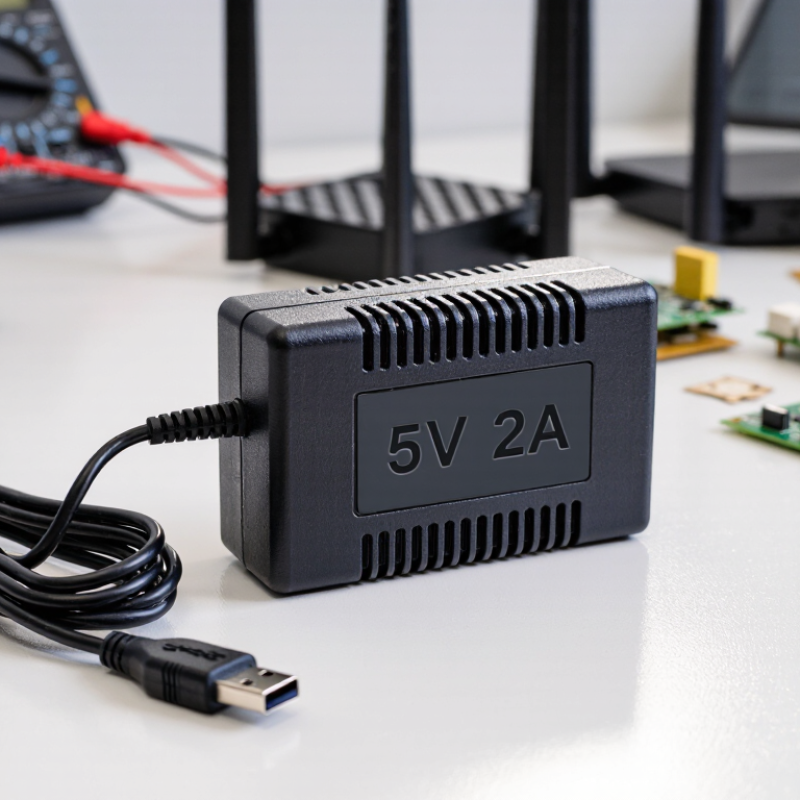
China Top AC DC Power Adapter 5V 2A Manufacturer
A 5 V × 2 A adapter delivers 10 W at its rated output. The calculation is simple. Real performance is not. Input voltage, temperature, cable resistance, and load behavior can reduce available power. A reliable unit should maintain close to 5 V from light loads to full 2 A operation, with controlled ripple and stable load regulation.
The U.S. Department of Energy Level VI efficiency framework evaluates active and no-load performance for external power supplies. Its limits encourage lower standby consumption and better conversion efficiency. For a 10 W adapter, even a small efficiency loss becomes visible as heat. At 85% efficiency, approximately 1.76 W becomes waste heat during full-load operation. That heat needs a safe path through the enclosure.
Industry testing commonly checks voltage accuracy, ripple, short-circuit response, insulation strength, and endurance under repeated load cycles. The International Energy Agency has also highlighted standby power reduction as an important efficiency opportunity across connected equipment. A compact 5 V 2 A adapter should therefore use adequately sized conductors, effective thermal spacing, and verified protection circuits. Tiny cases can look attractive. They may also trap heat. One practical weakness remains: a label showing 10 W does not prove continuous 10 W delivery. Bench testing at 25°C may differ from performance inside a warm cabinet. That assumption needs review.
| Specification | Typical Value | Engineering Meaning | Selection Notes |
|---|---|---|---|
| Adapter Type | AC-to-DC switched-mode power adapter | Converts utility AC into regulated low-voltage DC. | Suitable for compact electronics, control devices, sensors, and USB-powered equipment when connector and polarity match. |
| Rated Input Voltage | 100–240 V AC | Accepts common worldwide mains-voltage ranges. | Verify the product label before use; input frequency may be specified separately. |
| Input Frequency | 50/60 Hz | Supports the two standard commercial AC frequencies used in most regions. | Confirm the marked frequency range for the intended installation location. |
| Nominal DC Output Voltage | 5 V DC | Provides the target voltage for a 5 V electronic load. | The connected device should be designed for a regulated 5 V input. |
| Maximum Continuous Output Current | 2 A | The adapter can supply up to 2 amperes under specified operating conditions. | The load should not require more than the rated current. |
| Rated Output Power | 10 W | Calculated as 5 V × 2 A = 10 W. | Continuous operation at the maximum rating depends on temperature, ventilation, and the product specification. |
| Output Regulation | Regulated DC output | Maintains output voltage within a specified tolerance as input and load change. | Request the exact line- and load-regulation limits for precision applications. |
| Output Polarity | Commonly center-positive for barrel connectors | Defines the electrical relationship between the connector contacts. | Polarity must match the equipment; never assume it from the connector shape alone. |
| Connector Options | USB or DC barrel connector | The connector determines mechanical compatibility and may affect polarity identification. | Check plug size, contact arrangement, cable length, and current rating. |
| No-Load Power Consumption | Design-dependent; typically specified in the product datasheet | Indicates energy drawn while the adapter is connected but not powering a load. | Lower no-load consumption is preferable for permanently connected equipment. |
| Protection Functions | Over-voltage, over-current, short-circuit, and over-temperature protection | Protects the adapter and connected equipment during abnormal conditions. | Protection behavior and automatic recovery should be verified in the technical documentation. |
| Cooling Method | Natural convection; fanless design is common at 10 W | Transfers heat through the enclosure without a mechanical fan. | Do not cover the adapter; allow adequate airflow during continuous operation. |
| Operating Temperature | Model-specific; commonly 0–40 °C for consumer designs | Defines the ambient-temperature range for rated operation. | Use the manufacturer’s declared range for industrial, outdoor, or high-temperature applications. |
| Compliance Considerations | Applicable safety, EMC, and energy-efficiency requirements | Addresses electrical safety, electromagnetic compatibility, and energy performance. | Required markings and approvals vary by destination market and product category. |
It provides 10 watts. The calculation is simple: 5 volts multiplied by 2 amperes.
The adapter still consumes electricity when the connected device sleeps. Small losses accumulate while it remains plugged in.
A common U.S. benchmark is 0.10 watts. A stricter European target is 0.075 watts.
At 0.10 watts, continuous connection uses about 0.876 kilowatt-hours yearly. At 0.075 watts, it uses about 0.657 kilowatt-hours.
Test efficiency at 25%, 50%, 75%, and 100% load. Full-load testing alone can hide weak light-load performance.
Thermal inspection can identify hot transformers, switching losses, and undersized components. Heat is a warning sign.
Request voltage, ripple, load stability, temperature, insulation, and abnormal-operation test records. Confirm calibrated equipment and recent reports.
No. It shows documented quality processes, not perfect production. Check its scope, issuer, validity, and corrective-action records.
Review three recent batches instead of one attractive sample. Match carton codes, labels, and inspection records.
Ask whether units are repaired, investigated, or discarded. The answer may expose process weaknesses. I would not rely on assumptions.
An Ac Dc Power Adapter 5v 2a converts mains electricity into a stable 5 V, 2 A output, providing up to 10 W for compatible electronic devices. Designed for 100–240 VAC input, a compact flyback topology supports efficient power conversion while maintaining a practical size for external use. Reliable designs should incorporate appropriate protection against overvoltage, overcurrent, short circuits, and overheating.
For safety and market readiness, the adapter should be developed and tested according to IEC 62368-1 requirements for external power supplies. Efficiency is also essential: DOE Level VI and EU CoC Tier 2 benchmarks address average active efficiency and no-load power consumption. When evaluating a China-based manufacturer, buyers should review ISO 9001 quality management, electrical and safety testing capabilities, production traceability, documented inspection procedures, and compliance records. These factors help ensure consistent performance, dependable manufacturing, and suitability for international applications.