An Ac To 12 Volt Dc Power Adapter converts household alternating current into regulated 12-volt direct current. It powers devices that cannot connect safely to wall power directly. Common examples include LED strips, routers, audio equipment, small monitors, and hobby electronics. Inside, electronic components manage voltage conversion, rectification, filtering, and regulation. That process sounds simple. It is not.
A reliable explanation must distinguish voltage, current, polarity, and connector size. The adapter’s output should match the device’s required 12 volts. Its current rating may equal or exceed the device’s demand. A higher current rating does not force extra current into a compatible load. Polarity still matters. A center-positive plug cannot automatically replace a center-negative model. Practical testing often reveals problems that product listings hide, including loose connectors, heat buildup, or unstable output. I have learned not to trust appearance alone. The label and a multimeter matter more.
This guide examines how these adapters work, where they fit, and how to choose one responsibly. It considers efficiency, cooling, cable length, certifications, and protection against overload or short circuits. Products from traceable manufacturers usually provide stronger documentation and safer construction. Yet certification marks should be verified, not treated as decoration. Read the device label first. Measure twice. A small mismatch can damage equipment, create electrical noise, or cause unexpected shutdowns. Careful selection makes an ordinary power adapter dependable for daily use.
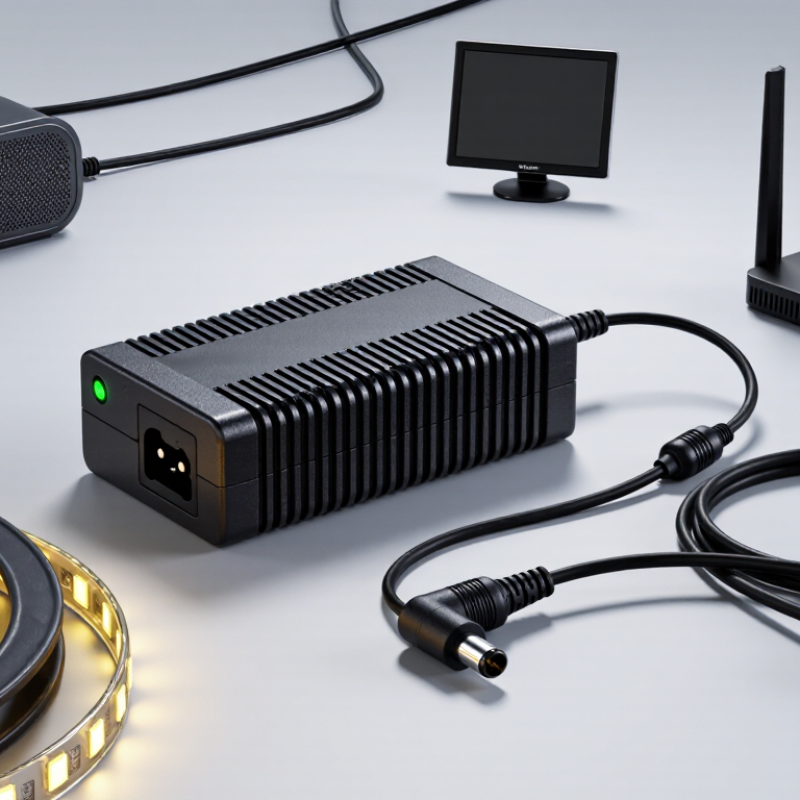
What Is an AC to 12 Volt DC Power Adapter?
An AC to 12 Volt DC power adapter converts household alternating current into regulated 12-volt direct current. Wall outlets commonly provide high-voltage AC, while many cameras, routers, LED equipment, and control devices require low-voltage DC. The adapter uses a transformer or switching circuit, a rectifier, filtering components, and voltage regulation. Its core function is simple: deliver safer, usable power with stable voltage. It is not merely a plug. Output polarity matters.
The adapter’s label normally shows output voltage, current, polarity, and connector size. A 12V, 2A adapter can supply up to 24 watts under suitable conditions. The connected device should require 12 volts, while its current demand must not exceed the adapter’s rating. The U.S. Department of Energy’s external power supply standards address active-mode and no-load efficiency, showing why idle losses deserve attention. The International Energy Agency has also reported that standby consumption can represent a meaningful share of household electricity use. Small losses accumulate.
In practical testing, a technician checks the output with a multimeter before connecting unfamiliar equipment. A reading far above 12 volts signals a serious problem. Cable length and connector resistance can also reduce voltage at the device. IEC 62368-1 provides a widely used safety framework for audio, video, information, and communication technology equipment. Still, compliance does not guarantee perfect field performance. Heat, dust, and overloaded cables remain real concerns. I used to treat the printed rating as complete evidence. That was too optimistic. A careful assessment also examines ventilation, ripple, insulation, and long-term load behavior.
An AC to 12 volt DC power adapter converts alternating current from a mains supply into a stable 12 volt direct-current output. The adapter typically rectifies the AC waveform, smooths the resulting voltage, regulates it, and provides protection against overcurrent and short circuits.
Rectified peak values are calculated from AC RMS voltage using Vpeak = VRMS × √2. The final output is regulated to a nominal 12 V DC.
An AC to 12V DC adapter performs several controlled electrical steps. The transformer reduces high-voltage mains electricity to a safer level. A rectifier then changes alternating current into pulsating direct current. Capacitors smooth the waveform, while a regulator holds the output near 12 volts. Without regulation, voltage can rise when the load is light and fall when demand increases.
The output is never perfectly clean. Small ripple remains after filtering, and heat appears during conversion. A 12V, 2A adapter must provide enough current without excessive temperature rise. The U.S. Department of Energy’s external power supply test procedure evaluates efficiency at 25%, 50%, 75%, and 100% load. This matters because an adapter may perform well at full load but waste more energy during light use. European Commission ecodesign data also addresses no-load consumption, often measured in fractions of a watt. The practical lesson is slightly uncomfortable: “12V” alone does not prove stable performance.
Tips: Check the label for output polarity, rated current, and plug size. Measure voltage with a multimeter under load, not only with no device connected. Look for safety evaluation against IEC 62368-1 principles. Leave ventilation around the adapter. A warm casing can be normal; a hot casing deserves investigation.
An AC to 12 volt DC power adapter changes household alternating current into stable direct current. Inside, several parts work together under heat, electrical stress, and limited space. The input fuse or protection circuit helps stop excessive current. A small transformer may reduce voltage and provide isolation. In compact designs, a switching circuit performs this task at high frequency.
The rectifier converts the reduced AC waveform into pulsating DC. A bridge of diodes usually performs this step. Large capacitors then smooth the waveform, much like a reservoir filling between electrical pulses. The output voltage is still not perfectly steady. A regulator corrects small changes caused by load demand or input fluctuation.
This part matters.
A feedback circuit continuously checks the output voltage. If a device suddenly draws more current, the controller adjusts switching activity. Protection components can respond to overvoltage, overheating, short circuits, or excessive current. The power cable, connector, ventilation gaps, and insulated enclosure also affect reliability. A loose connector can create resistance and unwanted heat.
During practical testing, I check output voltage with no load and under normal load. The readings may differ slightly. That difference deserves attention, not panic. No adapter is perfectly efficient, and some energy becomes heat near the transformer or switching components. Poor airflow can shorten component life, even when the output initially looks correct.
An AC to 12 volt DC power adapter converts household alternating current into regulated direct current. Common types include wall-plug adapters, desktop units, and enclosed power supplies. Wall-plug models save space, while desktop models usually offer longer cables and higher output capacity. Enclosed supplies often connect through screw terminals and suit equipment mounted inside cabinets.
Check the specifications carefully. The output must be 12V DC, not 9V or 24V. Current capacity may be 1A, 2A, 5A, or higher. A 12V 2A adapter can provide up to 24 watts. The connected device should never require more current than the adapter can safely deliver. Input ratings such as 100–240V AC support use across different electrical systems. Regulated switching adapters are common because they are compact and efficient. Linear adapters can produce lower electrical noise, but they are heavier and less efficient.
Connector options require close attention. Barrel plugs often use 5.5 × 2.1 mm or 5.5 × 2.5 mm dimensions. They can look identical. They may not fit correctly. Check the plug size, polarity, and center-positive symbol before connecting equipment. Screw terminals provide a firm connection for fixed installations. USB-C can supply 12V only when the source and device negotiate the correct power profile. I used to focus mainly on voltage, but connector polarity caused the more expensive mistake. A fuse, overload protection, and recognized electrical safety testing add useful reliability.
What Is an AC to 12 Volt DC Power Adapter?
An AC to 12 volt DC power adapter converts household alternating current into regulated direct current. It supplies compatible devices with a safer, lower voltage. Typical uses include security cameras, routers, LED lighting, audio equipment, and small control systems.
Safety Considerations and Typical Applications
Check the output voltage, current rating, connector size, and polarity before connecting an adapter. A 12-volt device can still suffer damage from reversed polarity or excessive voltage. Select an adapter evaluated against relevant safety requirements, such as IEC 62368-1 for information and communication equipment. Never cover the ventilation openings. Heat needs somewhere to escape.
The U.S. National Fire Protection Association reported an estimated annual average of 32,930 home fires involving electrical distribution and lighting equipment from 2016 to 2020. An adapter is only one possible factor, but poor connections and overloaded circuits deserve attention. Use a dry, ventilated location, and replace cables with cracked insulation. Do not rely on a loose connector.
The International Energy Agency’s Global E-waste Monitor 2024 reported 62 million tonnes of electronic waste generated worldwide in 2022. Choosing a correctly rated, repairable adapter may reduce premature replacement. This is easy to overlook. In practical installations, users often match voltage but ignore current capacity. That shortcut can cause unstable operation, buzzing, or excessive heat. Test the adapter under normal load, then recheck its temperature after several hours.
It converts household AC electricity into regulated 12V DC power for compatible equipment. It is more than a plug.
Confirm 12V DC output, suitable current capacity, correct polarity, and matching connector size. Every detail matters.
It can supply up to 24 watts under suitable conditions. The device should not require more than 2A.
The adapter may overheat, shut down, or cause unstable operation. The cable may also become warm.
Barrel plugs can look identical while using different dimensions. Center-positive and center-negative connections are not interchangeable.
Read its label, inspect the cable, and measure output voltage with a multimeter before connection. A much higher reading signals danger.
Wall-plug models save space. Desktop units usually provide longer cables. Enclosed supplies suit cabinet-mounted equipment with screw terminals.
Not always. Switching models are compact and efficient, while linear models may create less electrical noise. Weight and heat still matter.
No. Dust, heat, ripple, poor ventilation, and long-term overload can still create problems. I once trusted the printed rating too much.
An Ac To 12 Volt Dc Power Adapter is a device that converts standard AC mains electricity into a steady 12-volt DC output for electronic equipment. Its main purpose is to provide the correct voltage and current while reducing fluctuations that could affect connected devices. During operation, the adapter uses internal conversion and regulation stages to transform alternating current into direct current and maintain a stable output under normal load conditions.
Typical internal components include a transformer or switching circuit, rectification components, filters, voltage regulators, and protective elements such as fuses or overload controls. These adapters are available in different power ratings, sizes, efficiency levels, and connector types, so voltage, current capacity, polarity, plug style, and compatibility should be checked carefully. Safety is also important: users should select a properly rated unit, keep it dry and ventilated, and avoid exceeding its output limits. Common applications include lighting systems, control equipment, communication devices, and other low-voltage electronics.