Choosing an International Power Adapter is more than matching a plug to a wall socket. It is a small decision with practical safety consequences.
Imagine arriving at a hotel after a long flight. Your phone battery shows 8%, the socket is recessed, and your charger plug does not fit. A suitable International Power Adapter can solve that problem quickly. However, it cannot solve every electrical problem. Electrical-safety educator Mike Sokol offers a useful warning: “A plug adapter does not change voltage.”
That distinction matters. Travelers should check the device label before connecting appliances. Many chargers accept 100–240V, while some hair dryers, shavers, and older electronics do not. A reliable adapter should provide firm contact, heat-resistant materials, and clear country compatibility. It should not wobble inside the socket.
Convenience is important. Safety comes first.
USB-C ports can reduce luggage, especially during business trips. Yet, built-in ports may have limited power output. Fast charging is not guaranteed. This is where many buying guides become too confident. I have found that compact designs often hide compromises, including weak grips or unclear specifications.
A better choice considers destination, device wattage, socket design, and certification information. An International Power Adapter should support real travel conditions, not only attractive product photographs. The best model may be slightly larger, but easier to use and inspect. That trade-off deserves honest attention. A dependable adapter protects time, equipment, and peace of mind. Still, no product removes the need to read labels carefully.
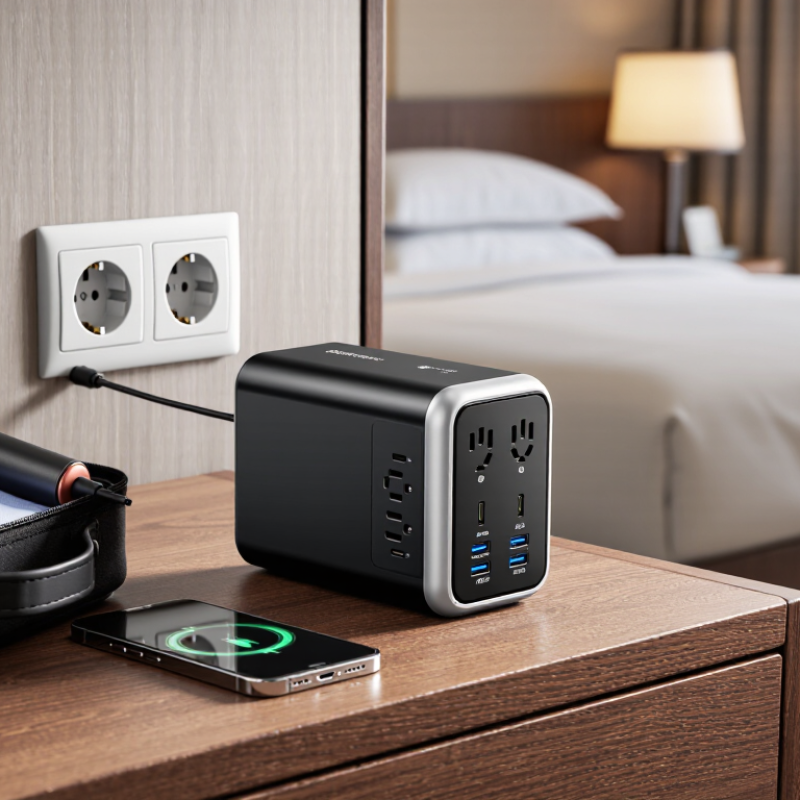
Why Choose an International Power Adapter?
What Is an International Power Adapter?
An international power adapter connects devices to wall outlets used in different countries. It changes the plug shape, not usually the voltage. A compact adapter may accept plugs from several regions and fit outlets with different socket designs.
This distinction matters. A phone charger rated for 100–240 volts can usually handle global voltage differences. A hair dryer designed only for 120 volts may need a voltage converter. An adapter alone will not protect it. IEC 60884-1 sets safety requirements for household plugs and socket outlets, but outlet standards still vary worldwide. According to UN Tourism’s World Tourism Barometer, international tourist arrivals reached about 1.4 billion in 2024. That scale makes reliable charging equipment more practical, not optional.
From travel experience, loose connections often appear in older hotel sockets. A universal adapter with firm contacts can reduce that frustration. Still, “universal” does not mean perfect. Some bulky designs block nearby outlets, and USB output ratings may be lower than expected. I once underestimated this detail while charging multiple devices. It slowed everything.
Tips: Check your device’s input range before departure. Match the adapter’s plug type to your destination. Choose grounded support for three-pin equipment. Keep a small spare cable, because adapters cannot repair damaged chargers. Consult your destination’s electrical guidance and the adapter’s certification details.
Why Choose an International Power Adapter?
How International Power Adapters Work
International travel reached about 1.4 billion arrivals in 2024, according to UN Tourism’s World Tourism Barometer. That scale makes electrical compatibility a practical concern, not a minor packing detail. An international power adapter changes the plug shape, allowing a device to connect with a foreign wall socket. It usually does not change voltage or frequency.
A simple adapter may accept a Type A plug and fit a Type C, G, or I socket. Its internal contacts route electricity to the matching pins. Some models include grounding paths, shutters, fuses, or overload protection. These features depend on the design and applicable safety standards, including IEC 60884-1. However, an adapter is not automatically a voltage converter. A 120-volt device can be damaged by a 230-volt supply. This mistake remains surprisingly common.
Tips: Check the device label before packing. “Input: 100–240V, 50/60Hz” usually supports worldwide voltage. A single-voltage appliance needs a properly rated transformer or converter. For USB charging, confirm the charger’s output, cable rating, and USB Power Delivery profile. Higher wattage is not always better. It can create heat, especially inside a crowded hotel socket. I would also avoid loose-fitting adapters; a small wobble can produce arcing, though this detail is easy to overlook.
| Data Dimension | How It Works or Typical Data | Why It Matters |
|---|---|---|
| Main Function | An international power adapter changes the physical shape of a plug so it can connect to a different wall-socket format. | It allows compatible appliances and chargers to connect while traveling without carrying several separate plug adapters. |
| Voltage Conversion | A basic plug adapter does not convert voltage or frequency. A separate voltage transformer or converter is required when the appliance is not compatible with the local supply. | Checking voltage prevents overheating, malfunction, or permanent damage to electrical equipment. |
| Common Supply Voltages | Many countries use approximately 220–240 V AC, while places including the United States, Canada, Japan, and parts of the Caribbean commonly use approximately 100–127 V AC. | The input rating printed on the appliance or charger should match the destination’s electrical supply. |
| Frequency | Electrical grids commonly operate at 50 Hz or 60 Hz. Some countries use both frequencies in different regions or systems. | Most electronic chargers tolerate both frequencies, but motors, clocks, and some heating equipment may require a specific frequency. |
| Plug and Socket Types | Common standards include Type A and B in North America and Japan, Type C and F in much of continental Europe, Type G in the United Kingdom and several associated regions, and Type I in Australia, New Zealand, and China. | A multi-region adapter reduces the need to identify and purchase a different plug adapter for every destination. |
| Grounding | Some adapters support grounded three-pin plugs, while compact travel adapters may accept only unearthed two-pin devices. | Grounded appliances should be used only with an adapter and socket that preserve the protective earth connection. |
| USB Charging | Many modern travel adapters include USB-A or USB-C output. USB-C Power Delivery can adjust charging voltage and current within supported limits. | Built-in USB ports can charge phones, tablets, cameras, and other compatible devices without separate wall chargers. |
| Power Rating | Adapters are generally rated by maximum current or power. A plug adapter itself does not increase the available wattage of the wall outlet. | The connected device must not exceed the adapter’s stated load rating, especially when several devices are connected at once. |
| Safety Shutters | Some adapter designs include shutters, insulated live pins, or covers that help prevent accidental contact with energized parts. | Protective features reduce the risk of electric shock during travel and everyday use. |
| Compatibility Check | Before use, compare the destination socket type, local voltage, frequency, appliance input range, grounding requirement, and adapter load rating. | A compatibility check is the most reliable way to determine whether an adapter alone is sufficient. |
| Best-Suited Devices | Dual-voltage electronics labeled, for example, “100–240 V, 50/60 Hz” generally need only a suitable plug adapter when used in another country. | This makes international adapters particularly convenient for laptops, phone chargers, camera chargers, and other switch-mode power supplies. |
An international power adapter matters because wall outlets are not globally standardized. The International Electrotechnical Commission identifies 15 common household plug configurations worldwide. Type A and B outlets serve the United States, Canada, Mexico, and Japan. Type C is widespread across Europe, while Type G is used in the United Kingdom, Singapore, and several Gulf countries. Australia, New Zealand, and Argentina commonly use Type I outlets. South Africa and India often use Type D or M designs. These differences affect physical fit, not always electrical safety.
Voltage also deserves attention. Most European countries use approximately 230 volts at 50 hertz. The United States and Japan commonly use 120 volts, with Japan operating at 50 or 60 hertz depending on the region. An adapter changes the plug shape. It does not automatically convert voltage. The IEC provides technical guidance for plug systems, while UN Tourism reported about 1.4 billion international tourist arrivals in 2024. That figure shows why one compact travel accessory may need broader outlet coverage. Still, “universal” can be an imperfect claim.
Tips: Check the destination’s outlet type, voltage, and frequency before packing. Confirm your device label says “100–240V” for dual-voltage use. Hair dryers and heated tools often require a converter. Test the adapter at home first. A loose fit is a warning, not a minor inconvenience. Carrying a small country-specific adapter may be safer than trusting every-in-one designs.
An international power adapter is a small tool with a serious job. Travelers use it to connect phones, laptops, cameras, and other devices abroad. I once packed a suitable plug adapter but ignored my laptop charger’s voltage range. That mistake caused unnecessary stress at a busy airport. An adapter changes the plug shape. It does not always convert voltage. Check the device label before connecting anything.
Businesses also rely on international adapters during conferences, inspections, and overseas projects. Employees may work from hotel rooms, shared offices, or temporary sites. A dependable adapter helps them stay reachable and protect essential equipment. It also reduces the need to borrow unfamiliar chargers. For professional use, grounded connections, firm sockets, overload protection, and recognized safety testing matter. Small details can affect productivity.
Tips: Check the destination plug type before departure. Confirm whether your device supports local voltage. Pack one adapter in your carry-on, not checked luggage. Test the adapter with a low-risk device first. Avoid loose connections and overloaded outlets. A compact design is useful, but compact does not always mean durable. I still need to improve my packing routine, because convenience can make people overlook basic electrical checks.
Travelers and businesses use international adapters because electrical standards vary by destination.
The chart compares typical household mains voltage and frequency across major travel and business regions. A plug adapter changes the physical plug shape, but it does not automatically convert voltage or frequency. Always check device requirements before connecting equipment overseas.
With international travel recovering strongly, adapter choice deserves more attention. UN Tourism reported about 1.4 billion international tourist arrivals in 2024. That means more phones, laptops, cameras, and medical devices crossing electrical systems. A suitable international power adapter should match both the destination socket and your device’s electrical needs.
Check voltage before checking appearance. Plug shapes vary, but voltage differences can damage sensitive equipment. Read the device label for input ranges, such as 100–240V. Choose an adapter rated for the required current and total wattage. A laptop charger may need far more power than a phone. Add the wattage of devices used together. Leave some capacity.
Grounding matters too. High-power appliances should not rely on a simple two-pin travel adapter. Look for shutters, strain relief, overcurrent protection, and recognized safety testing. IEC 60884-1 covers household plug and socket safety requirements, while IEC 62368-1 addresses many audio, video, and information-technology products. USB-C output is useful, but wattage claims can be confusing. Confirm the charging protocol and power delivery rating. Some compact models become warm under load. That is not automatically dangerous, but excessive heat deserves caution.
I once underestimated cable quality and charging speed suffered. The adapter was suitable; the complete setup was not. Check the socket, cable, voltage, and device together.
It changes the plug shape so your device can connect to a foreign wall outlet. It does not automatically change voltage. Check both before use.
Wall outlets use different physical designs worldwide. Type A and B are common in North America and Japan. Type C is widespread across Europe. Type G appears in the United Kingdom and several nearby regions. Type I is common in Australia, New Zealand, and Argentina.
No. A basic adapter only changes the plug shape. Many European countries use about 230 volts. The United States commonly uses 120 volts. A device marked “100–240V” usually supports both ranges. Do not guess.
Read the input label on the charger or device. Look for a range such as “100–240V.” Check the required frequency and wattage too. A phone charger and a hair dryer have very different demands.
You can, if its total wattage supports every connected device. Add the wattage of your laptop, phone, and camera chargers. Leave some capacity. Overloading can create heat and unstable charging.
They often require much more power than small electronics. A simple two-pin adapter may be unsuitable. You may need a properly rated voltage converter. Check the appliance instructions before packing it. Small does not mean safe.
Look for a firm socket, grounding where required, shutters, and overload protection. Recognized safety testing is also useful. Stop using an adapter that feels loose or becomes excessively hot. Heat deserves attention.
Yes. Test it at home with a low-risk device. Check whether the plug fits firmly and charging remains stable. Pack it in carry-on luggage for easier access. I sometimes focus on compact size and overlook cable quality. That is a mistake worth correcting.
An International Power Adapter is a practical travel accessory that helps connect electronic devices to power outlets in different countries. Because outlet shapes, plug designs, and voltage systems can vary around the world, the adapter acts as a bridge between a device’s plug and the local wall socket. Some models support multiple plug configurations and may include USB charging ports, making it easier to power phones, laptops, cameras, and other everyday electronics.
International Power Adapters are useful for travelers, remote workers, students, and businesses operating across borders. When choosing one, consider the countries you plan to visit, the outlet types they use, voltage compatibility, power limits, safety features, size, and the number of devices you need to charge. Selecting an adapter that matches your destinations and equipment can provide convenient, reliable power and help prevent compatibility problems during international travel.