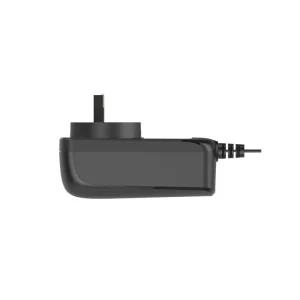
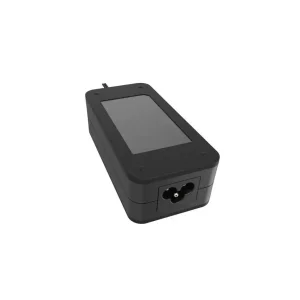
Precision-engineered power supply platforms tested for industrial, commercial, and consumer deployments worldwide.
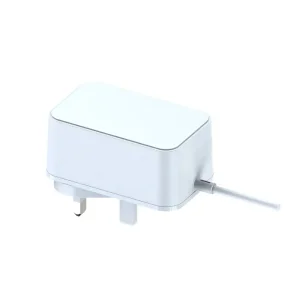
An Executive Analysis of Sourcing Dynamics, Regulatory Pressures, and Technical Standards in External AC/DC Power Adapters
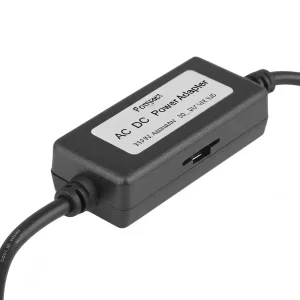
The global electronic landscape has transitioned irreversibly from legacy heavy linear transformers to high-frequency Switched-Mode Power Supplies (SMPS). Modern OEM/ODM applications require power conversion efficiencies exceeding 90%, ultra-low standby power (<0.075W), and compact form factors capable of handling wide universal AC input voltages (90V–264V AC, 47Hz–63Hz) across diverse global electrical grids.
Global regulatory bodies enforce stringent energy conservation measures. Today’s top-tier external AC DC power adapter manufacturers must comply with DoE Level VI (USA), EU ErP Tier 2 (European Union), and CoC Tier 2 standards. These mandates dictate strict active-mode average efficiency curves and enforce maximum permissible no-load power consumption to reduce carbon footprints.
Whether supplying Class I (3-pin grounded) or Class II (2-pin double-insulated) adapters, engineering teams must maintain strict internal creepage and clearance distances (>6.4mm) and primary-to-secondary isolation capable of withstanding hi-pot testing at 3000V–4000V AC. Electromagnetic Interference (EMI) filtering must comply with EN 55032 / FCC Part 15 Class B conducted and radiated emission limits.
How Wide Bandgap Semiconductors, Advanced Topologies, and USB Power Delivery 3.1 are Revolutionizing Power Density
Traditional silicon MOSFETs are reaching their physical limits regarding switching frequency and thermal resistance. Next-generation AC DC adapter factories in China are embedding GaNFast™ power ICs. Operating at switching frequencies upwards of 200kHz–500kHz allows the reduction of passive magnetic components (transformers and inductors) by over 40%, boosting power density to >1.5W/cm³ while operating substantially cooler.
For wall-mount and desktop adapters in the 15W–65W range, Quasi-Resonant (QR) Flyback remains cost-effective. However, high-power density switching power supplies are adopting Zero-Voltage Switching (ZVS) Active Clamp Flyback and LLC Resonant architectures. These topologies eliminate switching losses, reduce primary voltage spikes, and dramatically minimize Electromagnetic Susceptibility (EMS).
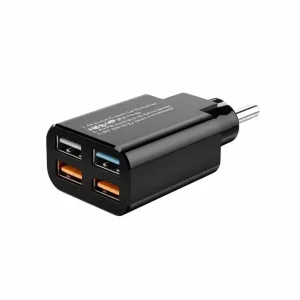
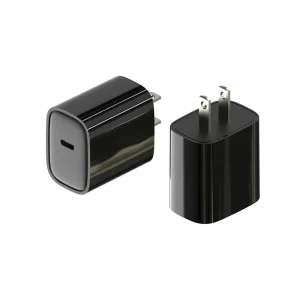
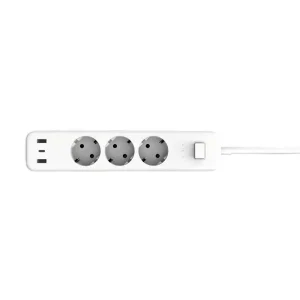
The convergence toward unified Type-C charging is accelerated by USB PD 3.1 EPR standards, enabling programmable voltage rails up to 48V DC and power delivery up to 240W. Smart power strips and multi-port desktop adapters dynamically negotiate voltage steps (5V, 9V, 12V, 15V, 20V, 28V, 36V, 48V) via microcontrollers using Programmable Power Supply (PPS) protocol, maintaining optimal charge curves for smartphones, laptops, and power tools.
Miniaturized sealed power adapters utilize high-thermal-conductivity potting compounds (silicone or epoxy encapsulants) and flame-retardant UL94 V-0 polycarbonate (PC) and ABS engineering plastics. This guarantees structural integrity during 1-meter drop tests and prevents thermal runaway under harsh industrial operating conditions (-20°C to +60°C).
Tailored Power Architectures Engineered for Diverse Commercial, Medical, Automotive, and Smart Automation Environments
Industrial automation hardware—including Programmable Logic Controllers (PLCs), Human-Machine Interfaces (HMIs), robotic sensors, and stepper motor actuators—demands rock-solid 24V DC or 36V DC voltage rails. In factory environments, voltage transients, inductive kickback, and electrical noise are common.
CCTV surveillance cameras, NVR/DVR security recorders, optical network terminals (ONTs), and 5G Wi-Fi routers operate continuously 24 hours a day, 365 days a year. Power interruption or high ripple voltage causes signal degradation, frame drops, or system reboots.
Portable medical devices—such as CPAP ventilators, blood pressure monitors, patient monitors, and Nebulizers—require strict isolation to protect both patient and operator against electrical shocks.
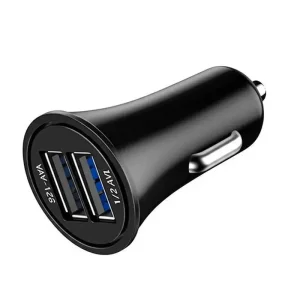
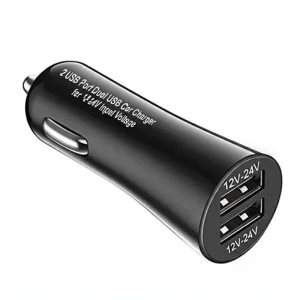
In-vehicle mobile chargers operating on 12V or 24V vehicle battery systems face load dump transients, voltage spikes, and severe vibration. Automotive fast chargers must deliver stable multi-voltage DC outputs to connected devices.
How Modern Shenzhen OEM Power Supply Factories Guarantee Cost Optimization, Quality Traceability, and Agile Prototyping
The core heart of an AC DC adapter is its high-frequency transformer. China’s advanced power adapter manufacturers maintain automated transformer winding, vacuum varnish dipping, and magnetic core assembly lines. Controlling transformer design reduces lead times for custom voltage turns-ratios and eliminates third-party component markup.
Surface Mount Technology (SMT) lines equipped with Solder Paste Inspection (SPI) and Automated Optical Inspection (AOI) ensure zero solder bridges or missing components. Every fully assembled board undergoes 100% automated electrical testing, 3000V AC hi-pot insulation checks, and 2 to 4 hours of full-load burn-in testing in heated chambers.
Housings are seamlessly sealed using high-frequency ultrasonic plastic welding machines, guaranteeing IP20 or higher enclosure ratings without requiring screws or toxic adhesives. Modular tooling dies allow rapid custom tooling modifications for custom DC plug tips, specialized cable lengths, and embossed brand logos.
Streamlined International Compliance Files Enabling Rapid Customs Clearance Across All Major Trade Regions
Full compliance with ANSI/UL 62368-1 standard, FCC Part 15 Subpart B Class B compliance, and DoE Level VI energy standards.
EN 62368-1 safety certification, LVD, EMC Directives, EU ErP Tier 2 efficiency, REACH, RoHS, and WEEE environmental compliance.
Mandatory China CCC (GB4943.1), Japan PSE Circle & Diamond (DENAN Law), Korea KC certification, and BIS safety registration for India.
Australia/New Zealand SAA electrical safety and RCM EMC mark. International IECEE CB Scheme reports for fast multi-country conversion.
Explore our complete production line of desktop, wall-mount, universal, and smart power adapters.
Technical clarifications and trade guidelines provided by our senior power electronics engineering team.