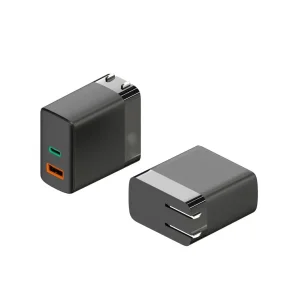
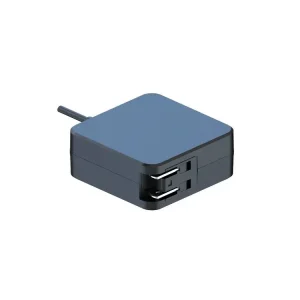
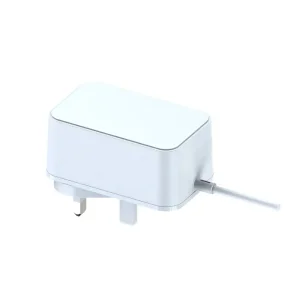
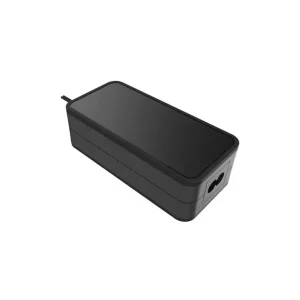
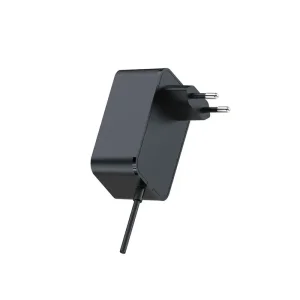
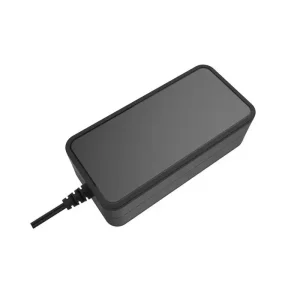
Explore our flagship switching power supplies engineered for global desktop computers, industrial workstations, and IoT terminal systems.
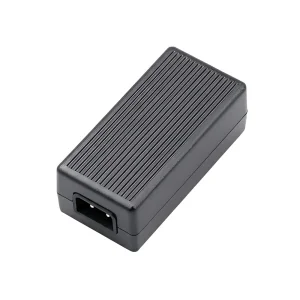
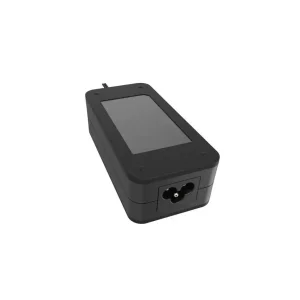
Analysis of power conversion dynamics, switching topologies, wide-bandgap semiconductors, and international efficiency compliance.
The global desktop computing ecosystem is experiencing a rapid technological transformation. Driven by compact form factors such as Mini PCs, All-in-One (AIO) desktop workstations, and Edge AI computation units, traditional silicon-based internal power supply units (PSUs) are increasingly being replaced by external desktop computer power adapters. Modern engineering demands higher switching frequencies to reduce passive component sizing. By integrating Gallium Nitride (GaN) and Silicon Carbide (SiC) field-effect transistors (FETs), manufacturers can achieve power densities exceeding 1.5W/cm³, allowing a 120W to 240W power brick to fit inside a ultra-compact housing with passive convection cooling.
Regulatory mandates across North America, the European Union, and Asia-Pacific have established strict limits on no-load power consumption and active-mode efficiency. Compliance with DoE Level VI (USA) and EU ErP Tier 2 (CoC Version 5 Tier 2) is no longer optional for enterprise procurement. Advanced Active Clamp Flyback (ACF) and Quasi-Resonant (QR) topologies are employed to maintain active efficiency above 90% across 25%, 50%, 75%, and 100% load states, while capping no-load standby dissipation at less than 0.075W to satisfy zero-watt standby green computing directives.
Information Gain Metric: Transitioning from legacy flyback designs to zero-voltage switching (ZVS) Active Clamp Flyback architecture cuts thermal generation by up to 38%, extending internal electrolytic capacitor lifespan by an average of 45,000 operational hours.
| Architecture Parameter | Legacy Silicon Flyback | Quasi-Resonant (QR) Flyback | GaN Active Clamp Flyback (ACF) |
|---|---|---|---|
| Switching Frequency | 45 kHz – 65 kHz | 65 kHz – 130 kHz | 300 kHz – 500+ kHz |
| Full-Load Efficiency | 82% – 85% | 87% – 89% | 92% – 95% |
| Power Density | 0.3 – 0.5 W/cm³ | 0.6 – 0.8 W/cm³ | 1.2 – 1.8 W/cm³ |
| Thermal Dissipation Profile | High (Requires Heavy Aluminum Heatsinks) | Moderate (Internal Copper Heat Spreaders) | Ultra-Low (Passive Thermal Compound Filling) |
| No-Load Standby Consumption | < 0.3W | < 0.1W | < 0.075W (ErP Tier 2 Compliant) |
Rigorous engineering benchmarks, electrical safety parameters, and certification mandates demanded by global OEM/ODM sourcing teams.
Global sourcing for desktop power supply units requires strict alignment with IEC/EN/UL 62368-1 (Hazard-based safety engineering standard replacing legacy UL 60950-1 and UL 60065). Enterprise buyers require verifiable test reports confirming creepage and clearance distances exceeding 6.4mm, dielectric insulation withstand capability up to 3,000V AC (Primary to Secondary), and continuous thermal monitoring under full load to prevent housing melting or risk of electrical fire.
Commercial and industrial desktop deployment demands stringent Electromagnetic Compatibility (EMC). Power adapters must integrate multi-stage EMI filter networks—comprising X/Y safety capacitors and common-mode chokes—to comply with FCC Part 15 Class B and EN 55032 Class B conducted and radiated emission limits. Active Power Factor Correction (PFC) stages ensure Power Factor (PF) > 0.95 at 115V/230V AC input, preventing grid harmonic distortion.
Reliability in fluctuating grid environments requires five core hardware protection loops: Over-Voltage Protection (OVP) via secondary Zener sensing; Over-Current Protection (OCP) with auto-recovery hiccup mode; Short-Circuit Protection (SCP) triggering under 0.1s; Over-Temperature Protection (OTP) utilizing internal NTC thermistors; and Surge Immunity up to 4kV (L-N) / 6kV (L-PE) compliant with IEC 61000-4-5.
How Chinese power electronics manufacturing clusters combine automated PCBA lines, vertical component integration, and strict QA protocols.
The primary competitive advantage of top-tier Chinese desktop computer power adapter manufacturers lies in complete vertical integration within the Pearl River Delta (Shenzhen, Dongguan) industrial hardware cluster. Rather than outsourcing sub-assemblies, advanced manufacturers maintain in-house high-frequency transformer winding workshops, automated SMT (Surface Mount Technology) placement lines, precision plastic injection molding facilities for flame-retardant ABS+PC (UL94 V-0 rated) enclosures, and ultrasonic shell welding robotics.
This concentrated ecosystem drastically reduces engineering cycle times for customized tooling, allows real-time inspection of planar magnetics, and eliminates component lead-time bottlenecks during global semiconductor supply chain volatility.
Leading China OEM factories operate under ISO 9001:2015 and ISO 14001 certification frameworks, replacing manual inspection with Industry 4.0 automated testing protocols. Every bare PCBA undergoes Solder Paste Inspection (SPI) and Automated Optical Inspection (AOI) to verify component positioning and solder integrity.
Following ultrasonic housing closure, 100% of finished units undergo 4 to 8 hours of continuous full-load aging test (Burn-in) inside elevated temperature chambers (40°C ± 5°C), followed by Automated Test Equipment (ATE) validation for ripple noise, voltage regulation tolerance (±3%), hold-up time (>16ms), and high-voltage dielectric withstand (Hi-Pot test).
Tailored power delivery engineering across diverse sector-specific deployments.
Modern corporate office infrastructures rely heavily on 65W to 135W compact desktop adapters (19V / 20V DC output). These units feature Line Drop Compensation (LDC) to account for voltage degradation across long DC cables, ensuring stable power delivery to high-frequency CPUs during burst computation workloads.
Desktop power supplies deployed in hospital environments must comply with IEC 60601-1 4th Edition. Requirements include 2xMOPP (Means of Patient Protection) insulation, ultra-low earth leakage current (< 100μA), and high immunity to ESD to prevent interference with sensitive diagnostic sensors.
Heavy-duty commercial applications such as retail POS systems, outdoor digital signage kiosks, and industrial PCs require power adapters rated for wide operating temperatures (-20°C to +70°C), conformal-coated PCBAs to resist moisture and dust, and custom lockable DC barrel connectors (Din-4, tuning fork, or screw-lock).
From technical specification review to mass production shipment—a step-by-step custom engineering roadmap.
Engineering discovery phase defining input voltage ranges (90-264V AC wide input), target voltage output curves, transient load response specs, DC cord gauge (16AWG / 18AWG), and custom connector pinouts.
3D CAD enclosure design and finite element thermal simulation. Engineering optimization of transformer layout, copper trace thickness, and heat-sink surface area for passive heat dissipation.
Working engineering samples delivered within 7 to 10 days. In-house laboratory pre-testing for EMI conducted emissions, surge withstand, efficiency curves, and thermal hotspot mapping.
Direct coordination with accredited testing bodies (TÜV, UL, SGS, Intertek) to acquire valid CB, UL/cUL, CE, UKCA, CCC, PSE, SAA, and KC certification reports under the client’s brand name.
Precision injection mold tooling creation. Pilot run of 500 to 1,000 units to calibrate SMT automated placement scripts, ultrasonic welding parameters, and packaging drop-test resilience.
Full-scale mass production (20–30 days lead time) with 100% electrical test record archiving. Laser marking of QR serial numbers on every adapter housing for 100% lot and component traceability.
Detailed technical solutions to standard engineering and supply chain inquiries from international enterprise buyers.
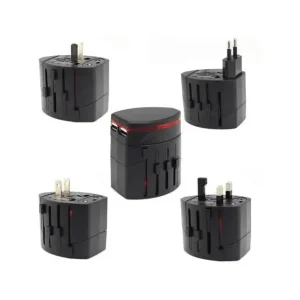
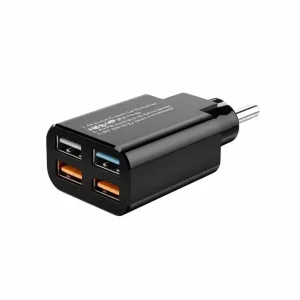
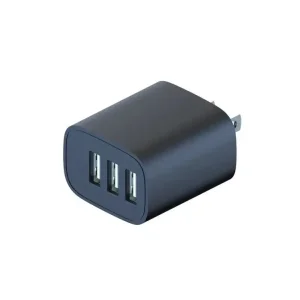
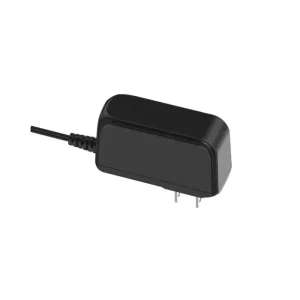
Discover our additional line of wall-mount power supplies, PD fast chargers, and universal desktop power adapters.