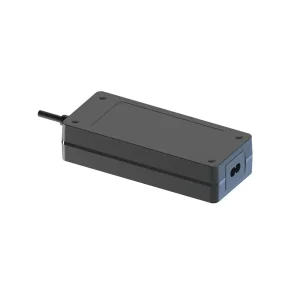
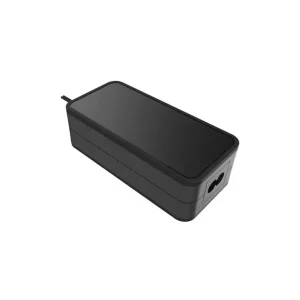
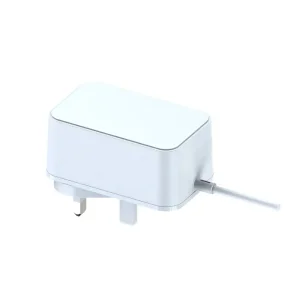
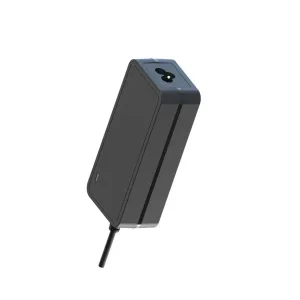
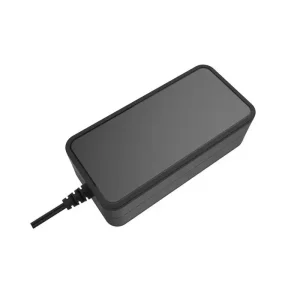
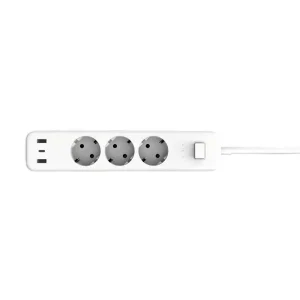
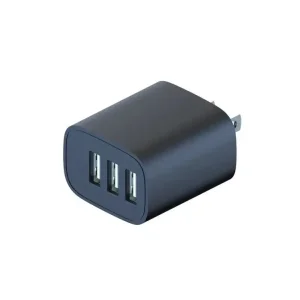
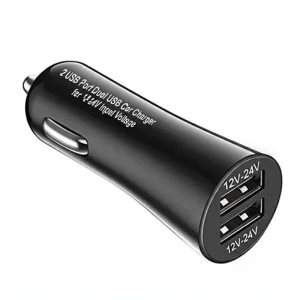
Explore our primary power conversion architectures, ranging from high-wattage automotive USB Type-C vehicular chargers to industrial-grade AC/DC switching power supplies designed for global OEM deployment.
The automotive power ecosystem is undergoing an unprecedented paradigm shift. Driven by the European Union’s mandatory Common Charger Directive (Directive 2022/2380) and global consumer expectations for rapid, high-wattage charging on the go, legacy USB-A ports (limited to 5V/2.4A 12W) are being rapidly phased out. In their place, advanced automotive-grade USB Type-C Power Delivery (PD 3.0 & PD 3.1) charging modules have become a standard benchmark for modern passenger cars, commercial vehicles, and Electric Vehicle (EV) architectures.
Modern vehicle occupants demand more than smartphone top-ups. Today’s automotive USB Type-C chargers must supply sustained power to power-hungry laptops (65W to 140W), tablets, gaming consoles, and drone battery docks directly from the vehicle’s 12V DC or 24V DC bus.
Unlike wall adapters, in-vehicle chargers operate in extreme ambient temperatures (-40°C to +85°C) and must tolerate harsh electrical environments, including cold crank voltage dips, load dumps (ISO 16750-2), and high-voltage transients (ISO 7637-2).
China has established itself as the global epicenter for automotive power electronics manufacturing. By leveraging complete supply chain integration—from raw Gallium Nitride (GaN) power ICs to automated SMT assembly—Chinese factories provide unmatched cost-efficiency, speed-to-market, and custom ODM flexibility.
Engineering a high-density, low-EMI car charger requires solving a core electrical puzzle: the vehicle's battery voltage fluctuates between 9V (during engine cranking) and 28V (in 24V commercial trucks or alternator load spikes), while the target USB-C PD output must dynamically supply 5V, 9V, 12V, 15V, 20V, or 28V (PD 3.1 EPR).
A standard Buck (step-down) converter cannot output 20V DC when the input battery drops below 12V DC. Advanced China USB Car Charger Type C factories implement 4-Switch Synchronous Buck-Boost Power Topologies. This architecture allows seamlessly smooth transition between step-down, pass-through, and step-up modes, maintaining stable output voltage without dropouts under all battery dynamic conditions.
| Architecture Parameter | Legacy Silicon (Si) MOSFETs | Next-Gen Gallium Nitride (GaN) Fast Charger | Automotive Grade OEM Advantage |
|---|---|---|---|
| Switching Frequency | 100 kHz – 250 kHz | 500 kHz – 2.2 MHz | Reduces inductor volume by up to 60%, creating ultra-compact flush-fit cigarette lighter form factors. |
| Power Conversion Efficiency | 85% – 89% | 94% – 98.5% | Minimizes internal thermal dissipation, eliminating plastic enclosure melting and performance throttling. |
| Thermal Rise (@ 65W Load) | > +55°C Ambient Rise | < +30°C Ambient Rise | Ensures stable long-term operation under high cabin temperatures without thermal shutdown. |
| Power Density | 0.3 W / cm³ | 1.2 W – 2.5 W / cm³ | Allows multi-port (Dual Type-C + USB-A) power delivery within an ultra-small housing footprint. |
| Dynamic Power Allocation | Fixed Power Split | Smart MCU Protocol Switching | Real-time power negotiation dynamically reassigns wattage (e.g., 45W + 20W or 65W single port). |
By utilizing wide-bandgap GaN semiconductors (such as Navitas, Power Integrations, or Innoscience ICs), our manufacturing lines produce ultra-high efficiency car chargers. Lower Rds(on) resistance directly reduces I²R conduction losses.
Integrated USB-PD controllers support a comprehensive array of fast-charging protocols including USB PD 3.0/3.1 with PPS (Programmable Power Supply), Qualcomm QC4+/QC5, Samsung AFC, Huawei FCP/SCP, and Apple 2.4A.
Every PCBA incorporates negative temperature coefficient (NTC) thermistors linked directly to the main power IC. If airflow is blocked, the MCU gracefully scales down charging current rather than abruptly disconnecting power.
When global brands, automotive aftermarket distributors, and OEM buyers source USB Car Charger Type C units from China, technical compliance and supply chain transparency are critical. Evaluation extends far beyond simple FOB unit cost to encompass holistic factory auditing, structural engineering capabilities, and warranty liabilities.
Bespoke injection molding, zinc alloy or anodized aluminum metal housings, laser-etched branding, custom LED halo light indicators, and localized retail box packaging.
Standard housing platforms support lower MOQs (500 – 1,000 units), while fully customized private-label tooling starts at 3,000 to 5,000 units with high-volume price break scales.
Strict Bill of Materials (BOM) control utilizing grade-A solid capacitors, flame-retardant PC plastics (UL94 V-0), and certified primary controller ICs to prevent batch variation.
Rapid rapid prototyping (5–7 days for samples) combined with automated SMT, ultrasonic welding, and continuous burn-in testing yields mass delivery in 20–25 days.
In-vehicle electronics operate in an electrically hostile environment. A non-compliant USB car charger can cause severe electromagnetic interference (EMI), disrupting key vehicle functions such as DAB radio reception, TPMS (Tire Pressure Monitoring Systems), GPS navigation, and keyless entry systems.
Our top-tier USB Car Charger PCBA designs incorporate multi-stage LC input filters, common-mode chokes, and shielded inductors. This ensures radiated and conducted electromagnetic noise strictly adheres to CISPR 25 Class 5 standards.
Vehicular electrical systems experience inductive load dumps when heavy motors turn off. High-energy Transient Voltage Suppressor (TVS) diodes absorb voltage surges up to 100V, protecting both the charger circuit and the connected smartphone.
Integrated hardware protections include Over-Voltage Protection (OVP), Over-Current Protection (OCP), Short-Circuit Protection (SCP) with auto-recovery, and Electrostatic Discharge (ESD) shielding up to ±15kV Air / ±8kV Contact.
12V/24V Vehicle Input ➔ Fuse / Reverse Polarity Diode ➔ TVS Surge Suppression ➔ Common Mode Choke & LC EMI Filter ➔ Synchronous Buck-Boost Controller (GaN FETs) ➔ Output Smart PD Protocol IC ➔ USB Type-C Connector (With Integrated Thermal Sensor)
To clear customs effortlessly and ensure hassle-free commercial distribution across North America, Europe, Asia-Pacific, and Latin America, car chargers manufactured in China must comply with localized regulatory standards.
| Target Market Region | Mandatory & Recommended Certifications | Compliance Technical Focus |
|---|---|---|
| European Union (EU) | CE, RoHS, REACH, E-Mark (ECE R10) | E-Mark is mandatory for automotive equipment installed directly in vehicles; validates EMC under EU directive ECE R10. |
| North America (US / CA) | FCC Part 15 Class B, UL 2089, Prop 65 | UL 2089 governs vehicle battery adapters to ensure fire safety, plastic flammability compliance, and enclosure strength. |
| Japan | PSE Mark (J62368 / J55032) | Ensures power conversion electrical isolation and radio interference protection under METI guidelines. |
| Global / Universal | USB-IF Certification, CB Scheme, IATF 16949 | USB-IF certification guarantees broad compatibility with standard Type-C cables and official Power Delivery protocol specifications. |
As vehicles transition into autonomous smart spaces and Electric Vehicles (EVs) become dominant, in-cabin charging requirements are evolving rapidly. Leading Chinese suppliers are pioneering several breakthrough innovations:
Future vehicular charging modules will supply up to 48V/5A (240W) over Type-C, enabling high-performance gaming laptops, mobile workstations, and power tools to run directly off vehicle power.
Integrated LIN (Local Interconnect Network) bus controllers allow the vehicle’s central infotainment computer to monitor charger thermal status, energy usage, and connected device diagnostics in real time.
Utilizing high-frequency GaN circuits allows chargers to shrink down so small that they sit completely flush inside the 12V socket, featuring pull-ring handles for seamless aesthetic integration.
Detailed technical answers to common queries raised during supplier auditing, contract negotiation, and engineering qualification.
Discover our broader lineup of desktop switching power supplies, high-wattage adapters, and smart multi-port strips tailored for home, commercial, and automotive ecosystems.