Direct factory solutions for global electronics OEMs, distributors, and industrial systemic integrators. Fully certified across major international compliance frameworks.
Understanding the shifting dynamics in global supply chains, regulatory mandates, and technological convergence in high-density wall-mounted power supplies.
The global market for wall mount power adapters (also termed wall-plug AC/DC power supplies or direct plug-in transformers) is experiencing a structural metamorphosis. Driven by the rapid proliferation of IoT edge devices, smart home automation, high-definition IP surveillance, telecommunication terminals, and portable medical hardware, the demand for compact, efficient, and regionally compliant power converters has reached unprecedented levels.
Historically, linear power supplies dominated low-power wall-plug applications. However, stringent statutory mandates such as the US Department of Energy (DoE) Level VI efficiency standard and the European Union’s Energy-related Products (ErP) Tier 2 directive have rendered linear transformers obsolete. Modern switching power supplies (SMPS) utilizing advanced pulse-width modulation (PWM) topologies and quasi-resonant switching now form the backbone of global wholesale supply chains.
Top-tier wholesale manufacturers must navigate a dense network of international safety and environmental regulations. Sourcing decision-makers are no longer evaluating suppliers purely on unit cost; total cost of ownership (TCO) and regulatory risk mitigation are paramount.
Wall-mount adapters entering North America must carry UL/cUL 62368-1 certification alongside FCC Part 15 Class B EMC validation. Products destined for the European Economic Area require CE marking under the Low Voltage Directive (LVD 2014/35/EU) and EMC Directive (2014/30/EU), supplemented by EN 62368-1 safety reports.
An engineering deep-dive into flyback converters, wide-bandgap (GaN) semiconductors, EMI filtering, and thermal management within enclosed plastic housings.
The single-ended isolated flyback converter is the dominant circuit topology for wall-mount adapters rated from 5W to 65W. By integrating primary-side regulation (PSR) or secondary-side regulation (SSR) via optocouplers and precision shunt regulators (such as TL431), manufacturers achieve tight voltage regulation (±3% to ±5%) and low ripple noise.
For power levels exceeding 18W, advanced suppliers transition to Quasi-Resonant (QR) flyback topologies. QR controllers valley-switch the primary MOSFET, minimizing capacitive switching losses ($P_{sw} = \frac{1}{2} C_{oss} V_{ds}^2 f_{sw}$) and substantially reducing electromagnetic interference (EMI) emissions.
The integration of Gallium Nitride (GaN) High Electron Mobility Transistors (HEMTs) represents a quantum leap in wall-mount adapter engineering. GaN switches possess significantly lower gate charge ($Q_g$) and zero reverse recovery time ($t_{rr}$) compared to conventional silicon MOSFETs.
This enables operating frequencies in excess of 200kHz to 500kHz without catastrophic thermal runaway. High-frequency operation directly reduces the volumetric requirement of passive components—specifically the main high-frequency transformer and electrolytic filter capacitors—yielding ultra-compact wall plugs with power densities exceeding 15W/in³ to 22W/in³.
Wall mount adapters operate inside unvented, sealed plastic enclosures to ensure user safety and prevent liquid/dust ingress (IP20 to IP67). Consequently, heat dissipation relies entirely on conduction from component heat sinks to internal poting compounds and radiation/convection through the enclosure surface.
Engineers utilize flame-retardant Polycarbonate/ABS resin rated to UL 94V-0. To pass EN 55032 Class B conducted and radiated noise thresholds, two-stage common-mode chokes, X2 safety capacitors, differential-mode inductors, and specialized transformer shielding techniques (such as copper foil Faraday shields) are embedded into the PCBA layout.
| Topology Type | Typical Power Range | Peak Efficiency | Standby Power Loss | EMC/EMI Complexity | Target B2B Applications |
|---|---|---|---|---|---|
| Standard Fixed-Freq Flyback | 3W – 15W | 78% – 84% | < 100mW | Moderate | Low-cost Routers, Smart Plugs, Toy Chargers |
| Quasi-Resonant (QR) Flyback | 12W – 45W | 86% – 89% | < 75mW | Low (Valley Switching) | Telecom Modems, STBs, POS Terminals, Security Cameras |
| Active Clamp Flyback (ACF) + GaN | 30W – 100W+ | 91% – 94% | < 30mW | Low-Medium | High-End USB-C PD 3.1 Chargers, Medical Devices, Laptops |
| Secondary-Side Synchronous Rect. | 18W – 65W | 88% – 92% | < 50mW | Low | High-Current 5V/12V Industrial Power Supplies |
Designing wall mount power adapters for seamless entry into multi-regional markets: fixed blade configurations vs. interchangeable AC head systems.
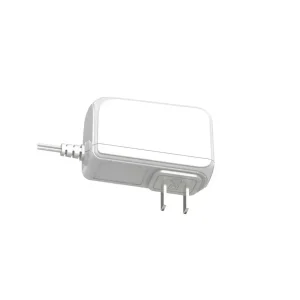
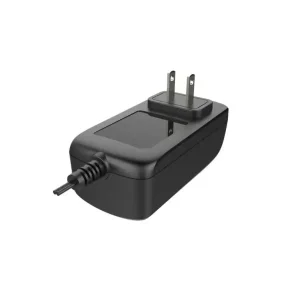
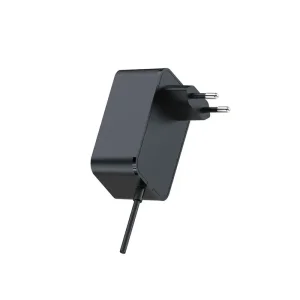
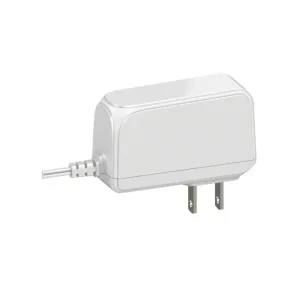
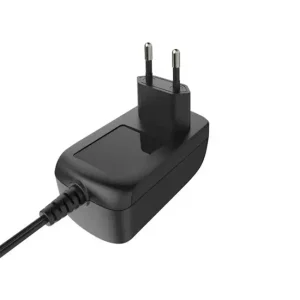
Fixed-plug wall mount power adapters feature integrated AC blade prongs molded directly into the outer thermoplastic enclosure. This mechanical structure offers superior mechanical rigidity, lower bill-of-materials (BOM) cost, and streamlined high-volume automated assembly.
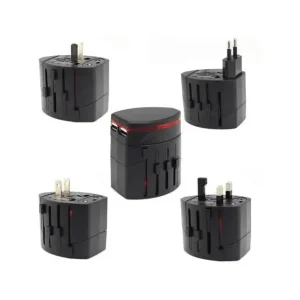
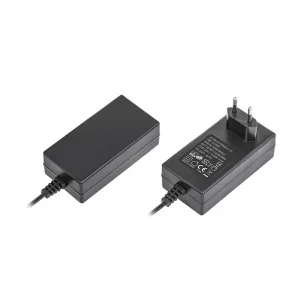
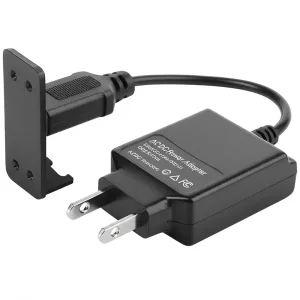
For OEM enterprise clients targeting simultaneous global product launches, wholesale manufacturers offer modular wall-mount adapters equipped with detachable AC clip-on heads. A single base switching power unit accepts interchangeable US, EU, UK, AU, CN, KR, and South African AC blade adapters.
Interchangeable AC clip adapters compress SKU complexity. Sourcing teams maintain a unified internal inventory of base power engines (PCBA + universal housing), snapping on regional AC pins at final packaging stage based on localized order fulfillment demands.
Tailoring electrical parameters, isolation barriers, cable harnesses, and protective enclosures to stringent vertical market requirements.
Medical-grade wall mount power adapters demand extreme electrical safety isolation. Devices interacting with patients or deployed in clinical environments must comply with ANSI/AAMI ES60601-1 3rd/4th Edition standards.
Engineers must implement 2x MOPP (Means of Patient Protection) isolation, providing 4000VAC primary-to-secondary dielectric strength, creepage distances > 8mm, and ultra-low earth/touch leakage current (< 100μA). Applications include CPAP machines, blood pressure monitors, pulse oximeters, and handheld diagnostic equipment.
Routers, Fiber Optic Network Terminals (ONTs), DSL modems, and VoIP gateways operate continuously (24/7/365). Wall mount adapters serving this domain prioritize extreme Mean Time Between Failures (MTBF > 100,000 hours at 25°C ambient under Telcordia SR-332 guidelines).
Output ripple and noise must be constrained below 100mVp-p to prevent data packet corruption or radio frequency jitter in Wi-Fi 6/7 transceivers. Integrated surge protection (typically 4kV to 6kV line-to-line differential mode) guards against lightning strikes on utility lines.
Smart doorbells, security cameras, wireless hubs, and automated window blinds require wall plugs with ultra-compact form factors that do not block adjacent AC wall outlets. Standby power consumption under zero-load conditions must not exceed 75mW (meeting EU ErP Step 2 and US DoE Level VI).
Secondary DC cord sets are engineered with high-flex strain relief boots and oxygen-free copper (OFC) wire gauges (18AWG to 24AWG) to eliminate voltage drop over extended cable lengths (up to 3 meters).
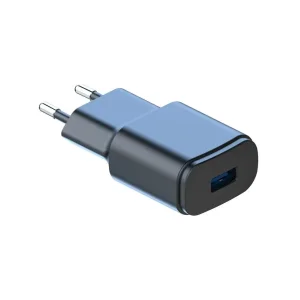
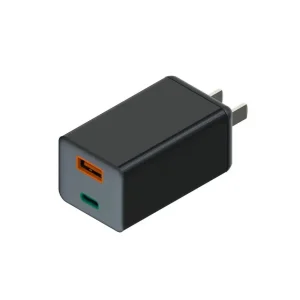
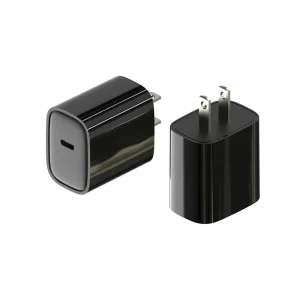
Modern wall mount chargers are transitioning rapidly from legacy fixed DC barrel connectors (5.5x2.1mm) to standardized USB Type-C interface sockets. Supporting Programmable Power Supply (PPS) protocols, these dynamic adapters negotiate output voltages seamlessly across 5V, 9V, 12V, 15V, 20V, and up to 28V/36V under USB PD 3.1 Extended Power Range (EPR).
Dynamic power allocation firmware prevents thermal overload during fast-charging cycles for laptops, smartphones, tablets, and handheld power tools.
Key technological vectors transforming wall adapter engineering over the coming decade.
Wider adoption of planar transformers, planar magnetics integrated into multi-layer PCB substrate layers, and high-frequency GaN/SiC switches will push power density beyond 25 Watts per cubic inch. Wall mount units will achieve 100W output in form factors previously restricted to 18W adapters.
Emerging EU CoC Version 5 Tier 3 draft standards target near-zero standby power draw. Advanced PWM controllers incorporate burst-mode control and automatic primary-side disconnect logic when secondary load detachment is detected.
Leading OEM suppliers are replacing virgin fossil-fuel ABS/PC with 50% to 85% Post-Consumer Recycled (PCR) plastics without sacrificing UL 94V-0 flame-retardant performance or ultrasonic weld joint integrity. Ultrasonic housing sealing eliminates screws, glue, and unrecyclable chemical adhesives.
A rigorous evaluation matrix for procurement directors and technical sourcing teams auditing power supply manufacturing plants in China and Southeast Asia.
To ensure batch-to-batch reliability and zero-defect shipments, qualified wholesale manufacturers enforce a 100% multi-stage testing procedure across all assembly lines:
| Audit Parameter | Mandatory Benchmark | Verification Method |
|---|---|---|
| Quality System | ISO 9001:2015 / ISO 13485 (Medical) | On-site / Third-Party Certificate Audit |
| Social Compliance | BSCI / SMETA 4-Pillar Audit | Valid Audit Report File ID |
| Safety Certificates | UL, CE, UKCA, CCC, PSE, KC, SAA | Direct Verification on Official Database (UL IQ) |
| Traceability | Barcoded Component & Batch Serialization | MES (Manufacturing Execution System) Audit |
| Environmental | RoHS 2.0 / REACH / California Prop 65 | SGS / Intertek Chemical Test Reports |
Expert answers to common technical, regulatory, and procurement questions raised by electrical engineers and enterprise buyers.
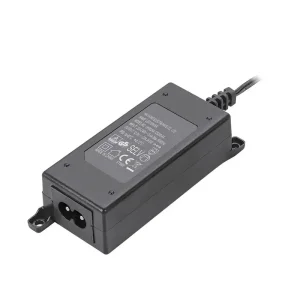
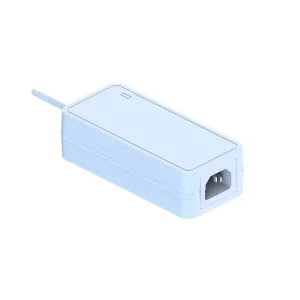
Wall mount power adapters feature AC plug prongs integrated directly into the housing body, plugging straight into an AC wall receptacle. They are typically optimized for power levels between 3W and 36W (up to 65W with GaN). Desktop power adapters connect to the AC mains via a separate AC inlet cord (C6, C8, or C14 connectors), allowing higher power output (typically 45W to 360W+) while keeping the heavy unit resting on a desk or floor.
These mandatory efficiency directives mandate minimum average active efficiency (measured at 25%, 50%, 75%, and 100% rated load) and maximum permissible no-load standby power consumption. Under DoE Level VI, power adapters under 49W must not consume more than 75mW under zero-load conditions. Compliance requires advanced PWM controllers with frequency foldback, burst mode operation, and secondary synchronous rectification switches.
Every industrial-grade wall mount power adapter must incorporate four primary protection mechanisms: Over-Voltage Protection (OVP) to prevent secondary circuit destruction; Over-Current Protection (OCP) with hiccup auto-recovery mode; Short-Circuit Protection (SCP) capable of continuous short circuit endurance without thermal damage; and Over-Temperature Protection (OTP) utilizing internal thermistors (NTC) to shut down switching when internal ambient temperatures exceed safety limits.
Under IEC 60601-1 medical device safety standards, MOPP stands for Means of Patient Protection, whereas MOOP stands for Means of Operator Protection. Patient contact applications require 2x MOPP, which enforces double isolation, a 4000VAC dielectric withstand voltage test, and minimum 8.0mm creepage and clearance distances. 2x MOOP requires only 3000VAC isolation and 6.0mm creepage, making it unsuitable for direct patient contact medical devices.
Standard off-the-shelf platform models with custom DC cable lengths or connectors typically start at an MOQ of 500 to 1,000 units per production batch. Fully custom OEM enclosure developments (requiring new injection molds and bespoke PCB layouts) usually require an MOQ of 3,000 to 5,000 units. Mass production lead times range from 20 to 30 days following golden sample approval and safety certificate filing.
Explore additional wholesale power models engineered for high MTBF, universal global inputs, and fast charging protocols.
Collaborate directly with our power supply design engineers. Receive tailored schematic proposals, DFM analyses, safety certification mapping, and competitive volume pricing within 24 hours.